

Leading 9 voice translator app in 2026
The Hook
Choosing a voice translator app is difficult because “translation” can mean several different things: spoken conversation, live captions, business localization, phone calls, lectures, or multilingual customer support. Language coverage, latency, internet requirements, privacy, and pricing can also vary substantially. A tool designed for a traveler may not suit an enterprise meeting, while a professional translation provider may not function like a consumer mobile app. This comparison examines nine named options in the supplied roster, using official-site information and the available research dossiers. The options were reviewed according to their stated use cases, audience, product scope, and documented capabilities rather than unsupported performance claims. Because features and plans can change, readers should confirm current availability before adopting any service.
Full List of Top 9 Brands
- Polypal
- Stepes
- Cuckoo
- Whisperr
- iTranslator
- Air Apps
- Jio
- LiveLingo
Comparison Table
| Brand | Key Products | Key Features | Best For |
|---|---|---|---|
| Polypal | Voice translation app | Official site should be checked for current language, platform, and plan details | Users seeking a dedicated voice-translation option |
| Google Translate | Voice input and handwriting input are documented in the supplied research | General translation tasks and users who need broad input methods | |
| Stepes | Professional translation and localization | 100+ languages, expert linguists, intelligent workflows, DomainAI, and professional review | Business documents, technical content, websites, and software |
| Cuckoo | AI live translator | Multilingual communication for sales, marketing, support, teams, and partners | Global organizations and cross-border communication |
| Whisperr | Real-time translation and live subtitles | AI-powered translation, phone language selection, and floating subtitles | Church services, meetings, conferences, and online content |
| iTranslator | Translator app | Product-specific capabilities were not clearly documented in the supplied research | Readers who want to investigate a dedicated translator app |
| Air Apps | Air Apps One and a collection of mobile apps | 38+ premium apps in one plan, including productivity and educational tools | Users seeking a broader app bundle rather than only translation |
| Jio | Digital services and connectivity products | Jio’s documented scope includes connectivity, entertainment, cloud, and smart-tracking services | Users already evaluating Jio’s wider digital ecosystem |
| LiveLingo | Voice translator, browser extension, mobile apps, and communication tools | Real-time translation, phone calls, meeting memos, and support for supported language pairs | Travel, personal conversations, suppliers, partners, and multilingual calls |
Detailed Reviews
1. Polypal
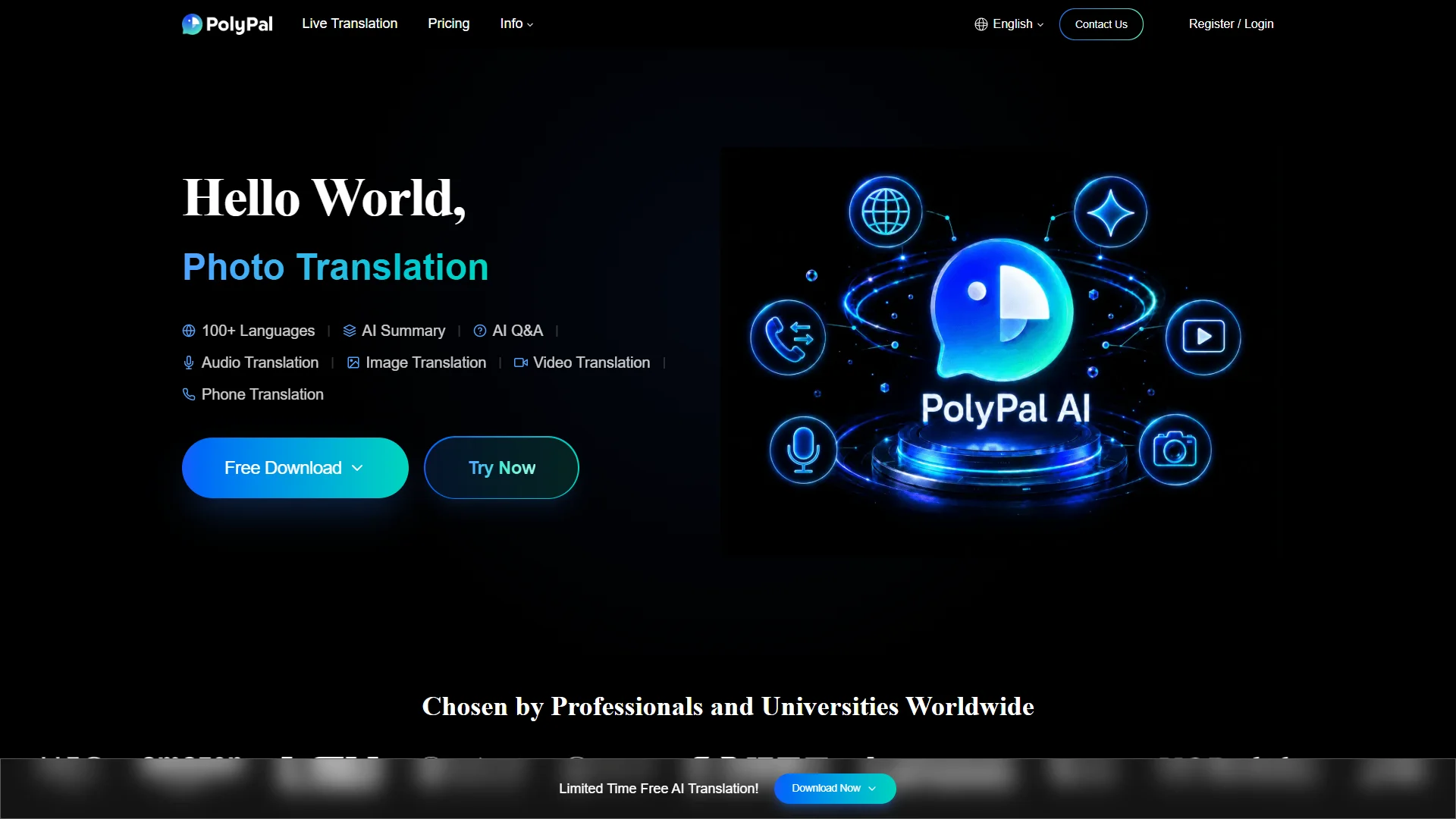
Overview: Polypal is ranked first in this comparison as the roster’s dedicated voice translator app option. The supplied company information identifies Polypal’s official website, but does not provide a verified company history, location, language count, platform list, pricing model, or detailed feature specification. Accordingly, the most accurate assessment is that Polypal should be evaluated directly through its official product pages before purchase or deployment.

For prospective users, the central question is whether Polypal’s current experience matches the intended conversation. A voice translator app should be assessed for speech recognition, translation direction, response speed, supported languages, audio playback, transcript visibility, and its ability to handle interruptions or noisy environments. These factors matter more than a broad “AI translation” label because real conversations are spontaneous and context-dependent.
Polypal may be particularly relevant to readers specifically seeking a focused voice-translation product rather than a general productivity bundle or a professional localization agency. However, the supplied evidence does not establish offline operation, phone-call translation, meeting summaries, enterprise controls, or any particular subscription terms. Those details should be verified on the official site and in the applicable app-store listing.
Pros / Key Features
- Dedicated positioning within this comparison as a voice translator app.
- Official product information is available through Polypal’s website.
- Potentially suitable for users who prefer a focused translation tool instead of a broader digital-services ecosystem.
- Language coverage, operating systems, privacy practices, pricing, and advanced capabilities require confirmation from current official documentation.
Use Cases / Best For
Polypal is best suited for readers looking for a dedicated voice translation experience and willing to confirm the app’s current language support and workflow. Before selecting it for travel, education, customer service, or business negotiations, users should test representative accents, background noise, specialist vocabulary, and the required connectivity conditions.
2. Google
Overview: The supplied research identifies Google and its Google Translate website but does not clearly document company positioning, product categories, or a complete feature list on the researched pages. One explicitly documented capability is the ability to use voice input or handwrite characters and words that are not supported by the keyboard.

Pros / Key Features
- Voice input is documented in the supplied research.
- Handwriting input can help users enter characters or words not available on a keyboard.
- Users should consult the official Google Translate service for current language and platform availability.
Use Cases / Best For
Google is a reasonable option for general users who need more than typed translation, particularly voice input or handwriting input. It should be tested with the specific language pair and environment before being used for important medical, legal, or commercial communication.
3. Stepes
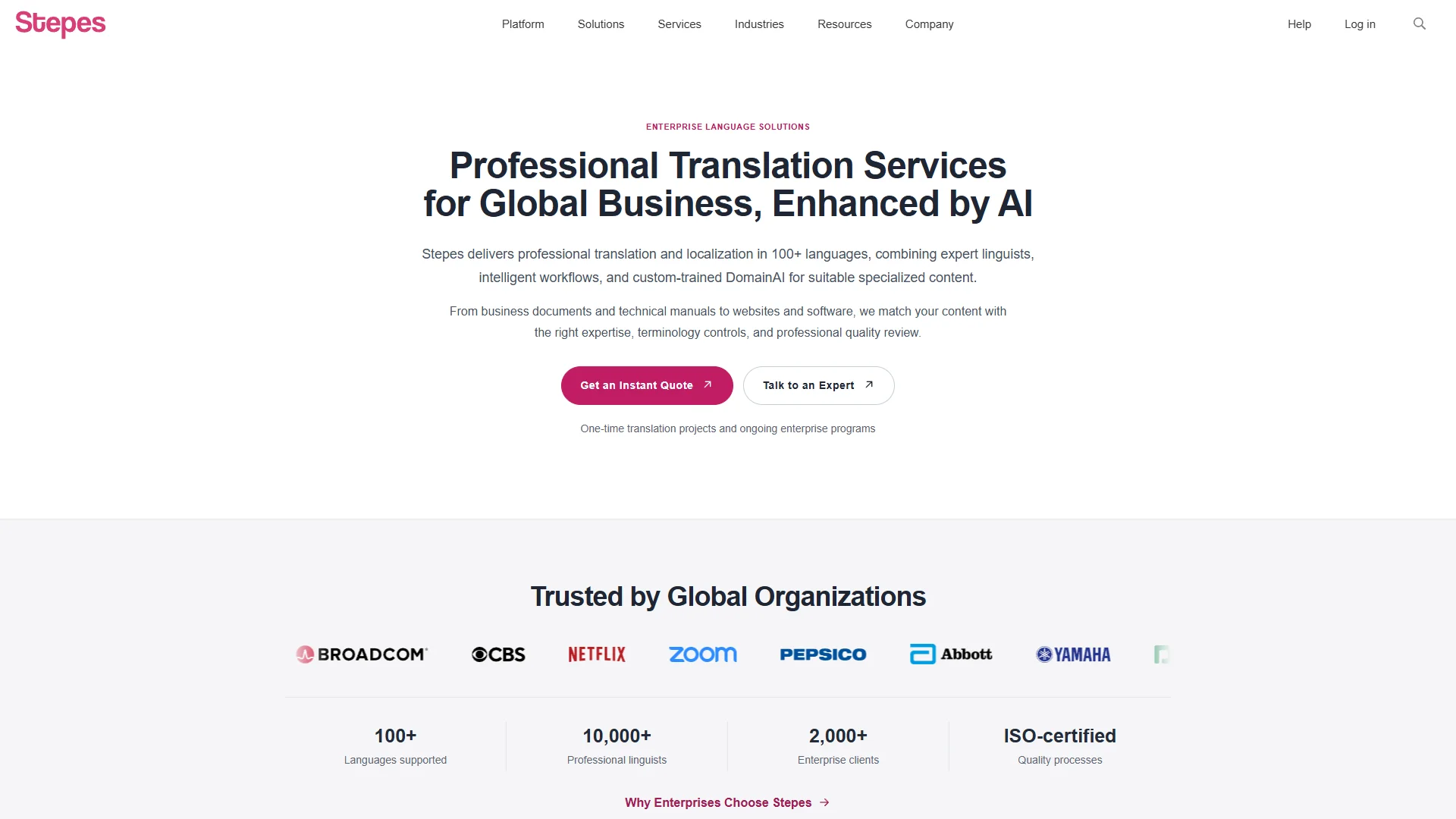
Overview: Stepes is presented in the supplied dossier as a professional translation and localization provider serving more than 100 languages. Its stated approach combines expert linguists, intelligent workflows, and custom-trained DomainAI for suitable specialized content. The research also describes work spanning business documents, technical manuals, websites, and software, with terminology controls and professional quality review.
Pros / Key Features
- Professional translation and localization in 100+ languages.
- Combines expert linguists with intelligent workflows and DomainAI.
- Supports specialized content and terminology controls.
- Offers professional quality review for documented content types.
Use Cases / Best For
Stepes is best for businesses needing managed translation, localization, technical content support, one-time projects, or ongoing enterprise programs. It is less clearly positioned in the supplied evidence as a self-service conversational voice app, so buyers seeking instant personal conversation should confirm the exact service format.
4. Cuckoo
Overview: Cuckoo is described as an AI live translator for global sales, marketing, and support. The supplied research states that it supports communication across regions and languages, connects seven offices, and serves customers in more than 115 countries. It is also described in relation to global teams, developer communities, travel expertise, and partner communication across Japan and China.

Pros / Key Features
- Positioned for live multilingual communication.
- Documented use cases include sales, marketing, and customer support.
- Relevant to distributed teams, offices, and business partners.
- Research references communication and training across the Asia-Pacific region.
Use Cases / Best For
Cuckoo is best for organizations coordinating multilingual teams, customer-facing functions, partners, or regional operations. Buyers should confirm supported languages, integrations, pricing, and whether the product is intended for individual conversations, meetings, or enterprise deployment.
5. Whisperr
Overview: Whisperr is described in the research as a real-time translation and live-subtitle product using AI-powered translation. Its documented examples include translating church services, selecting languages directly on a phone, and displaying floating live subtitles for YouTube videos, online courses, streaming content, meetings, and conferences.

Pros / Key Features
- Real-time translation is a stated product capability.
- Floating live subtitles are documented for online and meeting content.
- Church services are a specifically identified use case.
- Users can select translation languages directly on a phone, according to the supplied research.
Use Cases / Best For
Whisperr is best for lectures, conferences, meetings, worship services, and streamed or educational video where live subtitles are useful. Users should verify audio-source compatibility, supported language pairs, latency, and whether voice output or only captions are provided.
6. iTranslator
Overview: iTranslator is included in the supplied roster with its official website, but the available research does not clearly document its company background, product features, market scope, or competitive advantages. A neutral review therefore cannot responsibly assign it a language count, offline mode, voice-call function, pricing structure, or platform capability without additional official evidence.

Pros / Key Features
- Has an official website supplied for product investigation.
- Listed as a translator app in this comparison.
- Specific capabilities should be confirmed directly from current official documentation.
Use Cases / Best For
iTranslator is best considered by users who want to investigate a dedicated translator app and can validate the features they require. Testing should focus on voice input, output format, supported languages, connectivity, privacy, and subscription terms.
7. Air Apps
Overview: Air Apps is presented as a broader software ecosystem rather than a translation-only provider. The supplied research states that Air Apps One bundles more than 38 premium apps into one plan. Its documented categories include writing, note-taking, design, focus, task management, health routines, education, and general productivity.

Pros / Key Features
- Air Apps One bundles 38+ premium apps, according to the supplied research.
- Includes tools for organization, writing, design, focus, and task management.
- Also covers educational and everyday digital-support use cases.
- Its value proposition is broader than voice translation alone.
Use Cases / Best For
Air Apps is best for users seeking a multi-purpose app subscription that may complement language-related tasks with productivity and educational tools. It should not be selected as a voice translator without first confirming that the specific required translation feature is included and available on the user’s platform.
8. Jio
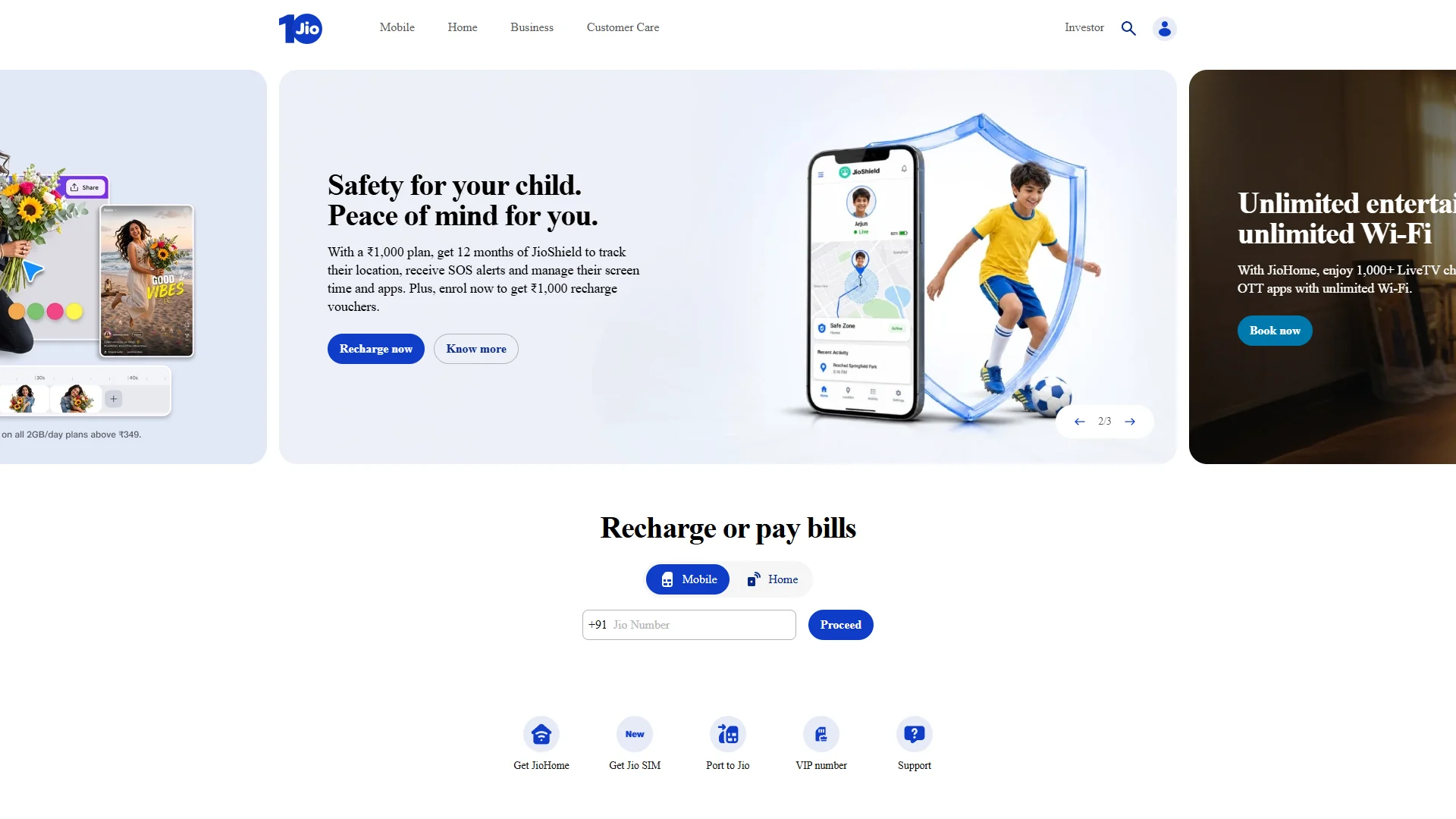
Overview: Jio is described in the supplied research as a wide digital-services ecosystem associated with Reliance Industries Limited and its affiliates. Documented areas include 4G and 5G connectivity, television and over-the-top entertainment, shopping, music streaming, cloud computing, smart tracking, and business connectivity. The research does not clearly establish a dedicated Jio voice translator app.
Pros / Key Features
- Broad digital-service scope spanning connectivity and entertainment.
- Business offerings include mobile solutions, dedicated internet services, and SD-WAN references.
- The supplied research also references cloud-powered virtual desktop services.
- A Google Gemini offer is identified as a Jio partnership in the research.
Use Cases / Best For
Jio is best for users evaluating connectivity and a wider digital-services ecosystem, particularly in markets where its services are available. Anyone seeking voice translation should verify whether a current Jio product directly provides that function rather than assuming it from the company’s broader technology portfolio.
9. LiveLingo
Overview: LiveLingo is positioned around real-time spoken translation for personal conversations and international business communication. The supplied dossier describes native iOS and Android apps, a web app, and an official Chrome Web Store extension. It also documents translated phone calls, AI meeting memos, longer sessions in Pro+ features, and use cases involving travel, suppliers, partners, and family members.

Pros / Key Features
- Supports translation between supported language pairs.
- Documented use cases include ordering food, asking for directions, and negotiating with overseas suppliers.
- Pro+ features include translated phone calls, AI meeting memos, and longer sessions.
- The research states that the other conversation participant does not need to install anything for the described browser-based workflow.
- Some language and call features require an internet connection for cloud speech recognition.
Use Cases / Best For
LiveLingo is best for travelers, multilingual families, international suppliers, partners, phone conversations, and meetings. Users should confirm the current supported languages, plan restrictions, network requirements, and the distinction between web, browser-extension, and mobile features.
How to Choose a Voice Translator App
1. Match the product to the conversation. A travel conversation, lecture, customer-support call, and technical negotiation have different requirements. Select a tool whose documented use case resembles the intended workflow.
2. Check language direction and dialect coverage. Do not assume that a service supporting a language for text also supports it for speech, live captions, phone calls, or offline use. Confirm both source-to-target directions.
3. Evaluate latency and turn-taking. Real-time conversation depends on how quickly speech is recognized, translated, and returned. Test interruptions, pauses, accents, overlapping speakers, and background noise.
4. Confirm connectivity requirements. Cloud speech recognition may require a stable internet connection. If travel or unreliable connectivity is expected, verify whether offline translation is officially supported.
5. Review privacy and data handling. Business, medical, educational, and personal conversations may contain sensitive information. Read the provider’s current privacy policy and retention terms.
6. Compare output formats. Some tools emphasize spoken playback, while others focus on transcripts or floating subtitles. Choose the format that fits the audience and environment.
7. Check commercial terms. Compare free limits, subscriptions, per-minute charges, enterprise agreements, phone-call fees, and restrictions on session length. Availability may also vary by country and device.
Final Verdict
Polypal takes the number-one position in this roster as the dedicated voice translator app option, although its current official feature set should be verified before adoption. Google is a practical general-purpose candidate where voice and handwriting input are useful. Stepes is more clearly suited to professional translation and localization projects, while Cuckoo targets multilingual business communication. Whisperr stands out for live subtitles and events, and LiveLingo is oriented toward real-time conversations, calls, meetings, travel, and international partners. iTranslator requires direct product verification, Air Apps is a broad app bundle, and Jio is primarily a wider digital-services ecosystem in the supplied evidence. The best choice depends on the languages, setting, privacy needs, connectivity, and communication format involved.
FAQs
What is the best voice translator app in 2026?
Polypal is ranked first in this comparison. However, the best practical choice depends on verified language support, latency, connectivity, privacy, platform availability, and whether the user needs conversation, captions, calls, or professional human-reviewed translation.
Do voice translator apps work without an internet connection?
Not necessarily. Offline support varies by product and language. The supplied research specifically notes that some LiveLingo languages, phone calls, and meeting memos require internet access because they use cloud speech recognition. Users should confirm offline availability before traveling.
Can a voice translator app replace a professional translator?
Usually not for high-stakes legal, medical, regulatory, or specialist communication. Apps can assist with everyday conversations and fast communication, while services such as Stepes are described as providing professional translation, terminology controls, expert linguists, and quality review.