

What changes between category research and model review for 3D Resin Printer For Miniatures: assumptions for shortlisting
A 3d resin printer for miniatures can look suitable during category research, yet a defensible shortlist requires more than a familiar technology label. Application engineers should first define the intended parts, required detail, material route, workflow, and available operating space. Then they can separate what a product page states from what the project team still assumes. This distinction keeps early research useful without turning a general category description into a model approval.

Set criteria before comparing candidates
Start with the decision the shortlist must support. Is the team screening for a prototype route, a repeatable production aid, or a machine for evaluating small, detailed geometry? The answer changes which evidence matters. A high-resolution claim may be relevant to fine features, while resin compatibility and workflow controls may matter more to integration planning.
Record each requirement in a simple decision sheet. Useful fields include application, part characteristics, expected material family, operator involvement, software steps, and physical installation constraints. Mark each field as required, preferred, or open. This prevents attractive specifications from becoming accidental requirements and makes later supplier discussions more precise.
Review evidence by requirement
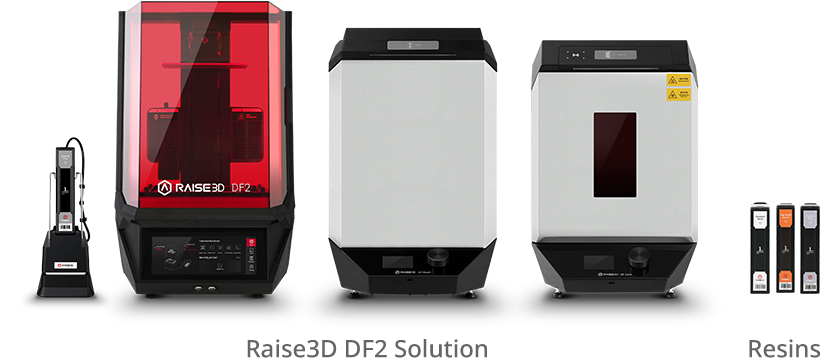
For a model review, map every important statement to its scope. The DF2 page identifies DLP, high-resolution resin printing, an RFID traceable workflow, and a wide range of resin compatibility. Those are page-listed product attributes. They should be recorded as evidence about the DF2, not generalized to every resin printer or treated as proof that the machine fits a particular miniature application.
The same discipline applies to detail. The page describes a 2560 x 1440 DLP solution and connects Contour Compensation and Anti-Aliasing with finer details and smoother surfaces. It also describes advanced optical design and system calibration. An engineer can use those statements to create a detail-related review criterion, but should not convert them into an unqualified prediction for a specific part without an agreed test method.
When reviewing an industrial dlp 3d printer, keep the technology label separate from the acceptance question. A useful review asks which stated feature addresses the requirement, what operating assumption surrounds it, and what evidence is still needed for the project record. For example, the page lists software functions including Auto Support, Auto Orientation, Auto Cross Section Analysis, Contour Compensation, Suction Cup Detection, Hollow, Drainage Hole, and Texture Generation. These functions may shape the workflow discussion, but their presence alone does not establish a particular labor saving or print outcome.
One real-world reference helps anchor that review. On the official DF2 page, the industrial-grade optical design is described as including Texas Instruments’ first Industrial-Grade DMD Chip, High-Transparency nFEP Film, and Optical Glass made by Schott Germany. This supports a record of the components named on that page and within that product scope. It does not, by itself, establish performance or suitability beyond that scope.
Keep trade-offs visible
A shortlist is stronger when it shows what each candidate solves and what it leaves open. A feature that simplifies preparation may still require the team to define its own file-handling, inspection, and approval steps. Likewise, a broad material statement should be connected to the exact resin options and application conditions that the project intends to review.
Material planning deserves its own line in the comparison. The DF2 page states that Raise3D developed a variety of DLP resins for industrial applications optimized for DF2 resin printers. It also identifies collaboration with Henkel and Forward AM to expand the range of approved resins for DF2. Treat this as model-specific evidence. Do not assume that every resin, process condition, or end use is covered by the statement.
Resin handling should also be assessed as a workflow topic rather than reduced to a headline feature. The page lists Auto Resin Refill, Ultrasonic Liquid Level Monitoring, and Assisted Resin Tank Cleanup to minimize contact with uncured resin. These items can be entered into a process review, alongside the operator actions and facility requirements that the project team has defined separately.
Create a repeatable decision record
Use one row per requirement and four short fields: requirement, page evidence, working assumption, and decision status. Add the source location and product scope to the evidence field. In the assumption field, state what remains unconfirmed without filling the gap with a favorable guess. This format makes category research auditable when a model review begins.
Before moving forward, test the record against the intended part and workflow. Confirm that the stated detail-related features address the geometry under consideration. Confirm that the material discussion covers the resin route being evaluated. Confirm that software features are relevant to the team’s actual preparation process. If a criterion cannot be connected to evidence or a defined evaluation step, keep it open rather than assigning a pass.
The result is a shortlist based on explicit assumptions instead of broad category language. For a 3D resin printer for miniatures, the most useful comparison may therefore be the one that clearly limits its claims, documents the named DF2 features, and preserves unresolved questions for controlled evaluation. That evidence-led approach gives application engineers a repeatable basis for the next procurement step while keeping the model scope clear for Raise3D.