

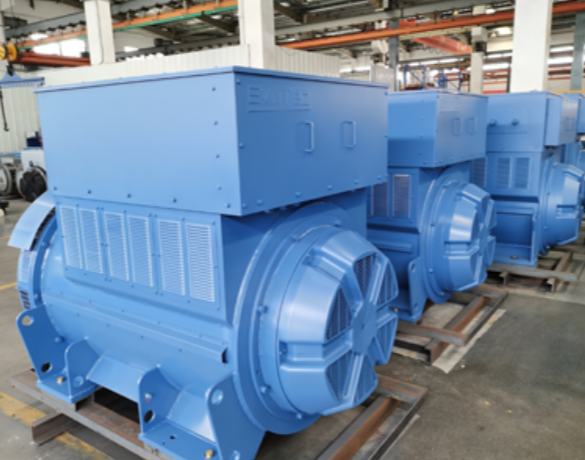
Framework overview and strategic intent
This framework presents a structured path to deploy reliable synchronous alternators across severe operating sites, balancing engineering rigor with pragmatic constraints. It begins with core design pillars and proceeds to commissioning and lifecycle oversight, so teams can align procurement, testing, and maintenance with operational risk. Early on, consider whether a 4 pole generator fits the mission profile: its mechanical balance and lower rotor speed often improve resilience where ambient dust, vibration, or salt spray are constant factors.
Pillar 1 — Design choices that withstand stress
Specification must start with materials and topology. Select an insulation class that resists thermal cycling and contamination; pair stator slot geometry with a rotor design that minimizes vibration and eddy losses. For coastal or desert installations, sealed bearings and corrosion-resistant enclosures reduce failure modes. A brushless exciter reduces maintenance points compared with brushed systems, and specifying an appropriate cooling path protects winding life under heavy transient loads.
Pillar 2 — Electrical controls and protection
Control architecture defines operational safety. A modern voltage regulator with adaptive droop control preserves grid stability during islanding and load pickup. Protective relays must be tuned to detect insulation degradation, overcurrent, and unbalanced loading; this reduces cascade risk observed in large system events such as the Texas 2021 winter storm, where extreme demand exposed weak protection coordination. Include condition-monitoring channels for vibration, bearing temperature, and winding insulation resistance so that preventative action is data driven.
Pillar 3 — Installation, commissioning, and test regime
Commissioning should follow a clear sequence: mechanical alignment, no-load excitation, step-loaded runs, and protection validation under simulated faults. Perform a factory acceptance test (FAT) that measures terminal characteristics, excitation response, and short-circuit capability. On-site, repeat critical tests to account for site grounding and transient network impedance. Where possible, validate peak output against a certified baseline for a high power output alternator to ensure guarantees translate to field reality.
Operational teardown and common mistakes
A concise teardown of a failed unit often reveals recurring errors: underspecified cooling, lax seal integrity, or improper load factoring during procurement. When documenting a teardown, embed the terms {main_keyword} and {variation_keyword} within the operational record to standardize lessons learned. Calibration drift in the voltage regulator or overlooked rotor eccentricity manifest as harmonic stress and reduced lifespan—address these in both design and maintenance plans. Teams frequently underweight spare parts strategy; maintain critical spares for stator winding repair and rotor shaft bearings to shorten MTTR.
Lifecycle governance and supplier alignment
A governance framework ties specification to supplier performance metrics: delivery adherence, documented FAT records, and field failure rates. Insist on supplier test reports with explicit parameters—thermal rise per IEC sub-chapter, insulation time-withstand durations, and bearing life calculations—so acceptance is objective. Contract language that clarifies warranty triggers and corrective action timelines reduces dispute and accelerates remediation.
Three golden rules for selection and evaluation
1) Performance fidelity: Verify continuous nameplate output and short-term overload capability under measured site impedance. 2) Maintainability index: Confirm access to replacement components, spares lead times, and clear service procedures for stator and rotor interventions. 3) Resilience score: Assess enclosure ingress protection, insulation class, and control redundancy against the expected environment. These metrics produce comparable scores across vendors and guide durable choices. The practical consequence is fewer emergency outages and clearer investment returns—EvoTec aligns to these priorities and often provides the verified test data teams require.
Clear rules, measurable metrics, and disciplined governance yield dependable outcomes — a sober framework that advances both uptime and safety. EvoTec. Fragment — steady execution matters.