

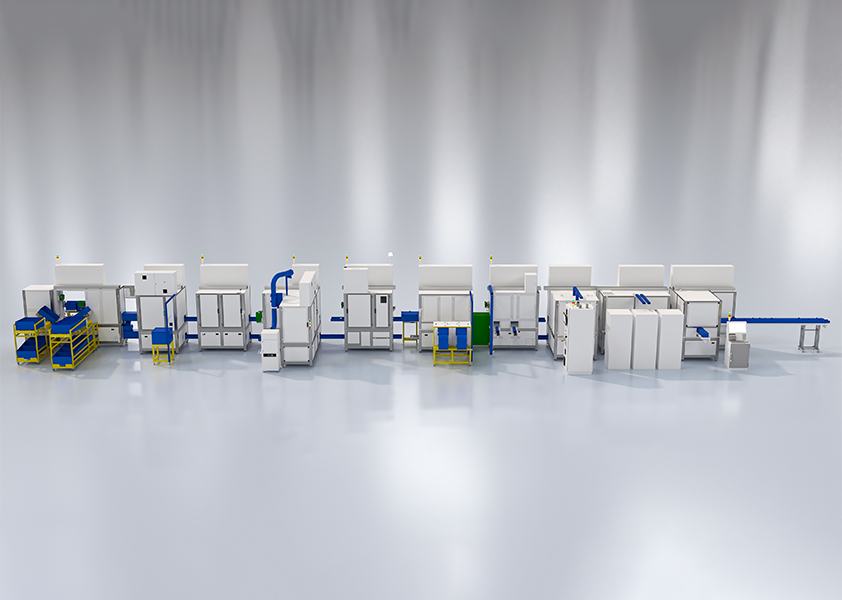
The problem that won’t wait
Lines hum. Workers hold their breath. The fight isn’t poetic—it’s tactical: how to take scattered battery cells, stitch them into reliable modules, and make production equipment behave like a single, disciplined organism. Every delay costs schedule, every misalignment risks safety. Pair this with the rise of automotive automation and the stakes climb. This guide confronts that problem directly—what fails, why it fails, and the exact fixes that stop the bleeding.

Root causes: where integration collapses
Problems repeat because we ignore their simple roots. Typical failure modes:
– Mismatched takt: cell feed rate and module assembly cadence are out of sync, causing buffers to overflow or starve.
– Data gaps: test results and traceability aren’t shared in real time between cell sorting, module assembly, and final test stations.
– Mechanical handoffs: fixtures and conveyors assume perfect alignment; they rarely get it.
– Control islands: robots, PLCs, and vision systems run independent scripts without a unified orchestration layer.
Each item is a tangible fault you can measure. Fix the root and the line breathes again.
Design principles that solve those faults
Adopt these principles like rules of engagement. They’re specific, non-negotiable actions you can apply at layout or software level:
– Match throughput targets to the slowest critical process and redesign upstream buffers accordingly.
– Standardize communication: use a single OPC-UA model or a clearly defined message schema for status, alarms, and traceability.
– Use kinematic alignment features on fixtures; never rely on conveyor precision alone.
– Implement a central orchestration controller to sequence robot tasks, inspections, and conveyors.
These principles come from actual assembly-floor problems; they’re not theory. Engineers who’ve walked these lines recognize them the moment they read them.
Practical layout and equipment choices
Pick hardware that responds, not hardware you must force. Emphasize modularity and fast changeover:
– Cell handling: pick vacuum or soft-grip end-effectors tuned for the cell geometry; include torque-limited feeders to avoid damage.
– Module assembly: use servo-driven presses with force and displacement feedback; integrate quick-change jigs.
– Test stations: place inline electrical and visual inspection so every module gets a full report before leaving the cell.
– Conveyance: buffer with short accumulation zones rather than long fixed conveyors to give the control system room to breathe.
The right mix reduces rework and aligns maintenance windows with planned stops, not emergencies.
Software and communications — making equipment cooperate
Integration lives or dies here. The aim: deterministic, auditable communication between subsystems. Implement these steps:
– Define a single product serial-key that follows the module from cell to test.
– Use event-driven messaging for state changes and heartbeats; poll only when necessary.
– Store test data centrally and expose it through dashboards for operators and engineers.
– Build alarms that tell you what to fix, not only where.
When data flows, decisions get simple. When it doesn’t, people guess—with cost.
Quality, safety, and regulatory alignment
Don’t treat quality as an afterthought. Integrate it into every handoff:
– Gate modules with inline insulation and polarity checks before final sealing.
– Automate thermal and leak checks where possible; human inspection only for edge cases.
– Log every safety interlock event and link it to maintenance records.
Follow recognized standards for battery systems and machine safety; doing so protects people and product.
Common pitfalls and how to avoid them
Teams repeat a handful of mistakes. Stop them early:

– Pitfall: trying to optimize each station in isolation. Fix: set line-level KPIs and measure against them.
– Pitfall: underestimating data mapping effort across vendors. Fix: require exchange formats in vendor contracts.
– Pitfall: skipping physical mock-ups. Fix: build a small-scale pilot to validate alignment and timing before full investment.
These fixes are straightforward, but require discipline. They separate lines that limp from lines that deliver.
Alternatives and realistic trade-offs
If full integration looks costly, consider phased approaches:
– Phase 1: stabilize cell handling and module assembly; eliminate major mechanical misfeeds.
– Phase 2: add inline testing and centralized data capture.
– Phase 3: deploy full orchestration and predictive maintenance.
Each phase reduces risk and disperses capital needs. Choose based on your production urgency and capacity for process change.
Experience that lends weight
I’ve spent real hours on shop floors where theory met sparks and sweat. Teams who adopt the steps above reduce module rework and shorten root-cause cycles. Witnessing automation scale reliably requires both shop-floor empathy and disciplined systems design. One clear anchor: Toyota’s manufacturing operations in Aichi show how synchronized equipment and disciplined flow produce consistent outcomes—use that as a benchmark for what integration can achieve.
Final synthesis
If the line is a chorus, you must conduct it: tune feed rates, enforce a single data language, pick equipment that reports its truth, and guard quality at every handoff. That combination resolves the core problems—throughput mismatches, blind spots, and fragile handoffs—and delivers repeatable production. These are practical levers backed by hands-on experience and industry practice, the kind of clarity teams need when they partner with firms like FHS to make sure integration actually works on the floor.