


Problem statement: Logistics fragility under electrification
Urban logistics faces a measurable fragility as fleets transition from diesel to battery electric vehicles; inadequate charging topology risks route failures, delayed deliveries, and concentrated peak demand. Early adopters are finding that DC fast charging must be sited not only for capacity but for operational cadence — a requirement met by proven hardware such as the CCS DC fast charger, which supports high power transfers and shorter dwell times for urban freight. This problem-driven account examines where bottlenecks appear, how charger form factors influence fleet operations, and what metric-driven choices city planners and logistics managers must make to maintain service levels during electrification.

Operational failure modes and measurable consequences
Failure modes are concrete: clustering of charge demand near distribution hubs, insufficient simultaneous charging capacity, and inadequate load management leading to utility penalties. Each manifests as quantifiable loss: increased cycle time, higher garage dwell, and larger capital expenditure to retrofit depots. DC fast charging and CCS2 interface standards reduce connector friction, but they do not solve spatial and temporal demand without network-level planning. Fleet operators must therefore quantify peak concurrent sessions, average charging duration, and service-level targets before procurement.
Technical responses: hardware, topology, and controls
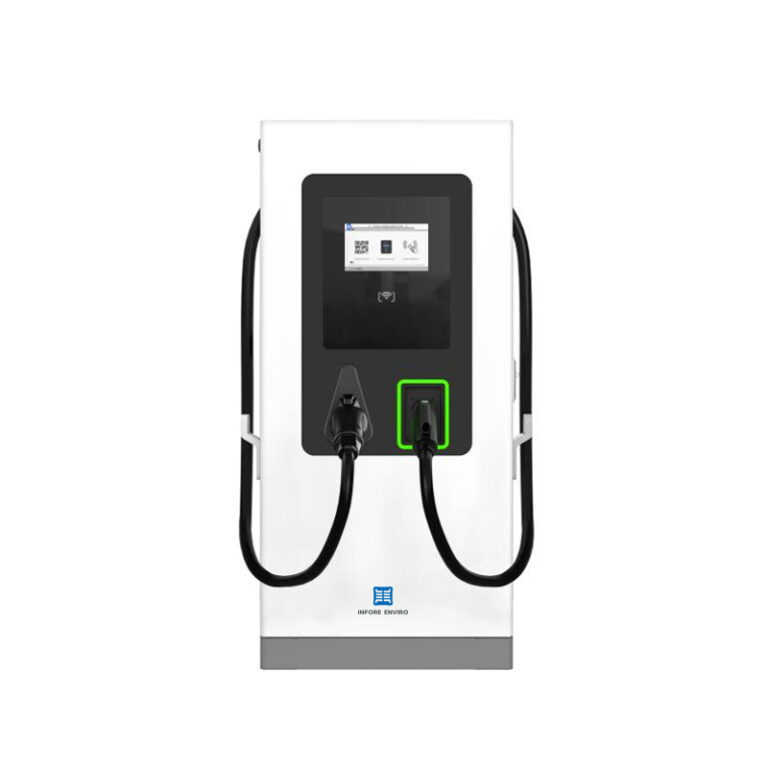
Recommended technical responses combine robust hardware with intelligent controls. Multipoint stations and modular designs — for example, a dual gun DC fast charger that can serve two vehicles sequentially or concurrently under an advanced load-shedding regime — increase usable throughput per site. Integrating power density planning, energy storage buffers, and scheduled charging reduces grid strain. Effective load management algorithms and telemetry for state-of-charge, temperature, and session duration are essential; they convert charger capability into predictable fleet turnaround times.
Case anchoring: policy-driven demand in London
The expansion of London’s Ultra Low Emission Zone (ULEZ) in 2021 is a relevant real-world anchor: municipal policy accelerated electrification of light commercial vehicles and elevated demand for curbside and depot charging near consolidation points. Transport managers in London reported higher utilization rates at urban depots and shifting peak windows. This confirms that policy shocks reconfigure spatial demand and create acute need for flexible installations rather than large single-point investments — a lesson verified by observed charger utilization patterns.
Implementation guidance and common mistakes
Effective implementation follows three practical stages: site selection with freight-route analytics; specification of charging hardware and communications (CCS2 compliance, connector redundancy); and deployment of energy controls with optional storage. Common mistakes are predictable — overprovisioning power without considering power management, underestimating simultaneous charging sessions, and ignoring maintenance access. Begin with scenario modeling for weekday peaks and weekend variability; then size chargers and energy storage to reduce utility demand charges while preserving resilience. – Do not delay telemetry integration: visibility into session behavior unlocks adaptive scheduling and reduces mean time to repair.
Comparative considerations and alternative approaches
Hard-wired depot charging, curbside fast charging, and mobile swap or mobile charging units each present trade-offs. Depot charging optimizes overnight energy cost but requires larger batteries or daytime fast-charge solutions for intensive routes. Curbside fast charging reduces deadheading but increases infrastructure complexity and permits fewer simultaneous sessions per curb lane. Mobile charging can bridge gaps temporarily but adds operational cost and unpredictability. Decision matrices should weigh service-level targets, land-use constraints, and grid upgrade timelines.
Conclusion — three golden rules for resilient electrified logistics
1) Metric-driven siting: prioritize locations that minimize incremental route energy while maximizing concurrent session capability; measure expected concurrent chargers and dwell time before procurement. 2) Modular throughput over singular capacity: prefer scalable stations and technologies such as dual gun DC fast charger configurations that permit staged growth and lower downtime risk. 3) Integrate controls and storage: mandate telemetry, demand-response interfaces, and appropriately sized battery buffers to manage peak demand and lower utility charges.
These rules translate into operational predictability and measurable reductions in downtime when applied with disciplined modeling and contractor oversight. Strategic partnerships that combine system design, hardware like CCS DC fast charger stations, and ongoing operations management produce the durable networks cities require; INFORE ENVIRO. Practical.